Updated November 2026. Push first published this post in 2024. A lot has happened since then, so we've refreshed it so it remains accurate.
If you go back a decade or more, phishing used to mean a fake login form that captured a username and password. As MFA became more widespread, a stolen password stopped being enough, because the attacker also needed the code or push approval at the moment of login.
Attackers adapted with adversary-in-the-middle (AiTM) phishing, which relays the whole login, MFA included, and keeps the session at the end. When Push first published this post in 2024, AiTM was moving from red team tools into criminal phishing kits. Two years later, it's the standard technique for credential phishing. It gets around most forms of MFA, and even passkeys when the account has a weaker backup method that the kit can downgrade to.
New: AiTM phishing in 2026 | DOM mirroring is the fastest-growing AiTM technique. See how it works and which kits use it →
What is AiTM phishing?
Adversary-in-the-middle (AiTM) phishing is a technique that uses dedicated tooling to act as a proxy between the target and a legitimate login portal. The attacker relays the login to the real site in real time and captures the session that the site issues at the end. Because the attacker steals an authenticated session rather than just a password, most forms of MFA don't stop it.
Attackers typically target single sign-on (SSO) portals such as Microsoft Entra, Okta, or Google Workspace. One SSO session opens every app that trusts that identity provider (IdP). From there, they can read email and files, register their own MFA methods to keep access, and pull data from connected SaaS apps like Salesforce.
In 2026, AiTM accounted for 44.6% of all phishing techniques Microsoft identified in its 2026 Digital Defense Report, making it the most prevalent phishing technique recorded. eSentire found that phishing-as-a-service (PhaaS) kits were behind 63% of the account compromise incidents it investigated in its 2026 Threat Report.
AiTM is also referred to as attacker-in-the-middle or reverse proxy phishing. Push's Browser & Identity Attacks Matrix tracks it alongside the other browser-based phishing techniques.
AiTM phishing isn't session hijacking. Session hijacking, also called token replay, steals a session that already exists, such as a cookie that infostealer malware takes from the victim's device. AiTM phishing needs no malware on the device. It sits in the middle of the login and captures a new session as the victim creates it.
How an AiTM attack works
In an AiTM attack, the victim signs in and completes MFA, and the attacker keeps the resulting session. A typical attack on a Microsoft 365 account runs in five steps:
Lure. The victim gets a link by email, QR code, search ad, LinkedIn or Teams message, or a phone call. In Push's detections, one in two phishing payloads arrive outside email.
Gate. Bot checks such as Cloudflare Turnstile and browser fingerprinting send scanners and sandboxes to a harmless page. Only a real person in a real browser gets through.
Credential relay. The victim enters their email address and password, and the kit relays each one to the real IdP. The kit also pulls back the company's own sign-in branding.
MFA relay. The real IdP sends an MFA challenge, and the kit shows the matching prompt. The victim types the code or approves the push notification, and the kit relays that too.
Session theft. Once MFA is complete, the real IdP issues a session cookie to the attacker's server. The kit sends the victim on to the real site, and the attacker loads the cookie into their own browser.
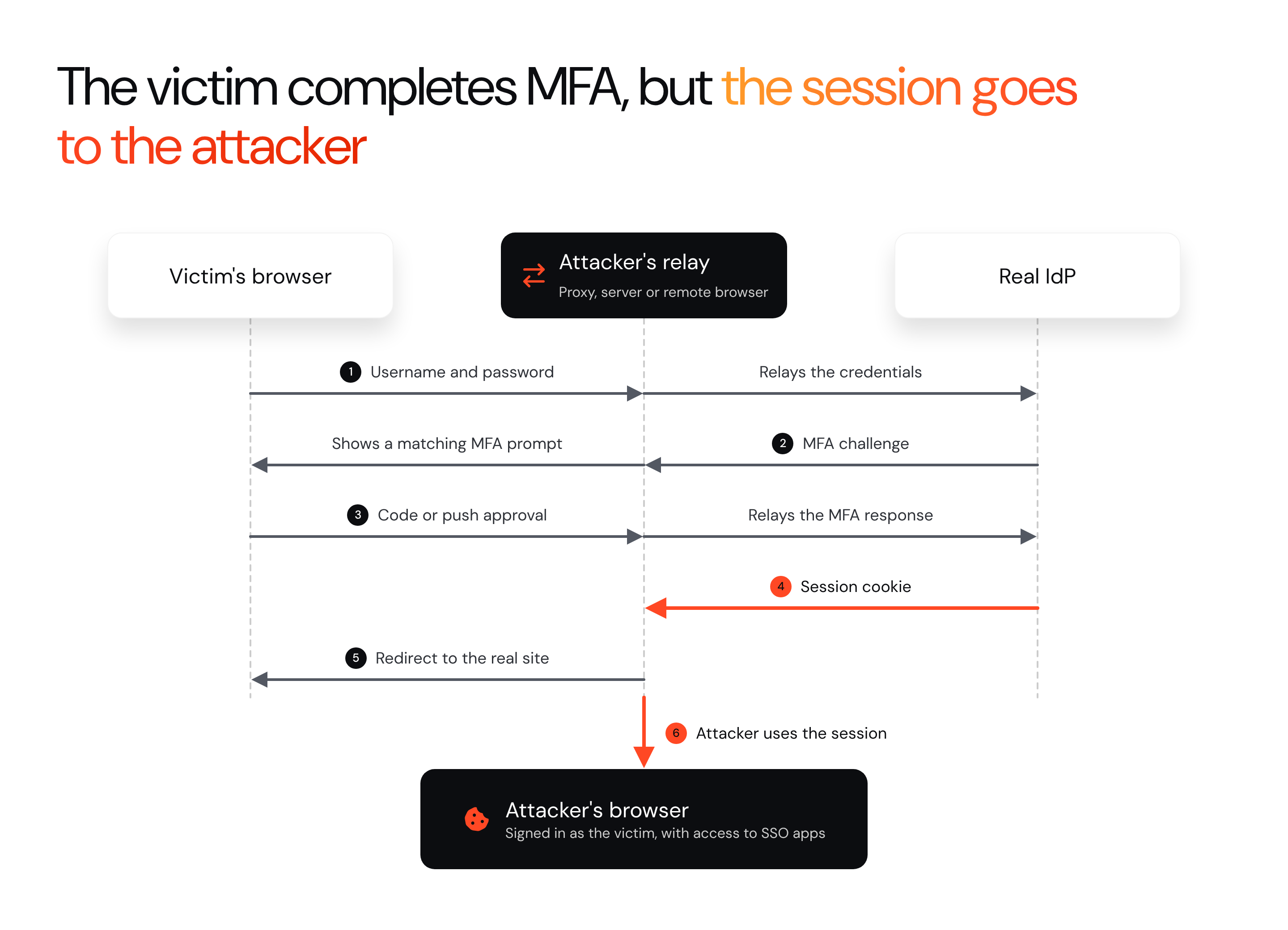
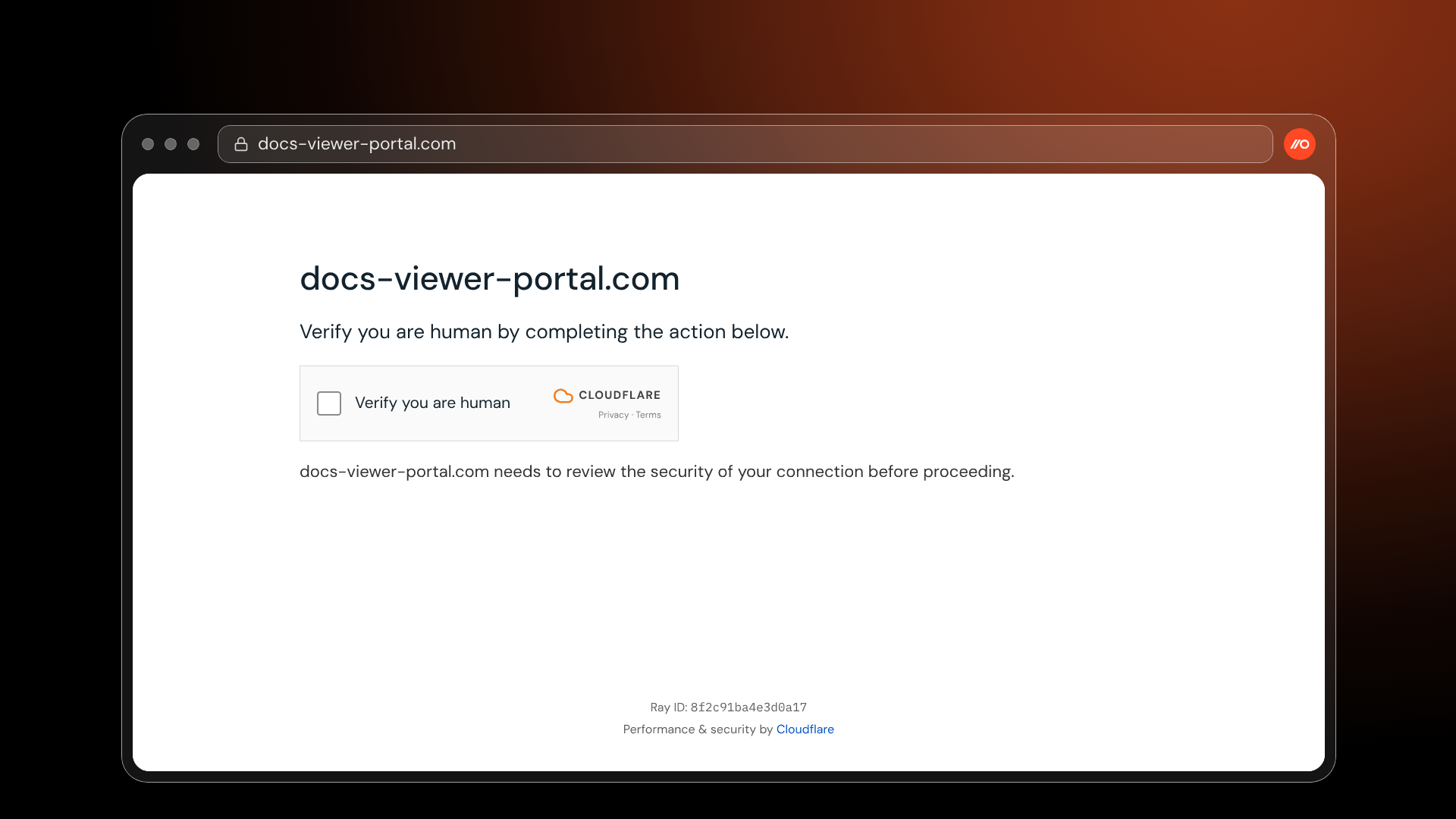
The attack bypasses most forms of MFA, like SMS codes, authenticator apps, push approvals, and number matching. FIDO2 security keys and passkeys are tied to the real site's domain, so a proxy can't complete the login. That's why kits now try to downgrade those methods to something weaker (going around the passkey instead of through it). Others switch to authorization phishing, such as device code and OAuth consent attacks. The victim completes a genuine login on the real site and hands the attacker access, so passkeys don't stop it.
Transparent proxies and custom front ends
Most AiTM kits show the victim a login page in one of two ways. A transparent reverse proxy, such as Evilginx, Modlishka, or Muraena, fetches the real login page, rewrites its links, and serves it from the attacker's domain. Most criminal PhaaS kits, including Tycoon 2FA and Sneaky 2FA, show a copy of the page that they host themselves, often an AI-generated lookalike. Behind that page, the kit's server drives the real login and relays each step. This gives the kit author full control over the page, which makes it easier to add bot checks and obfuscation. Some kits run a real browser on attacker infrastructure instead, which the next section covers.
Whichever mechanism a kit uses, the user sees a convincing login page, the app sees a normal login with MFA, and the attacker gets a valid session at the end of it.
Browser-in-the-middle (BitM)
In a browser-in-the-middle attack, the attacker opens the real login page in a browser on their own server. The victim controls that remote browser through a stream that looks like an ordinary web page, so the session lands in the attacker's browser. Early tools such as EvilnoVNC and Cuddlephish streamed video and were awkward to scale. Newer kits now stream the page's DOM and rebuild it in the victim's browser.
BitM is harder to spot than a proxy. The sign-in runs in a real browser, so it doesn't trip checks for proxies or automation, and the session never leaves the attacker's browser to be replayed elsewhere. In the victim's browser, the page is just a stream, and plenty of legitimate tools, such as remote desktop and browser isolation products, stream pages the same way.
Browser-in-the-Browser (BitB)
BitB is a visual layer on top of an AiTM relay. The kit draws a fake browser pop-up inside the page, with an address bar that shows the real login URL as a picture. Because the fake address bar shows the real login URL, a user who checks the URL sees nothing wrong.
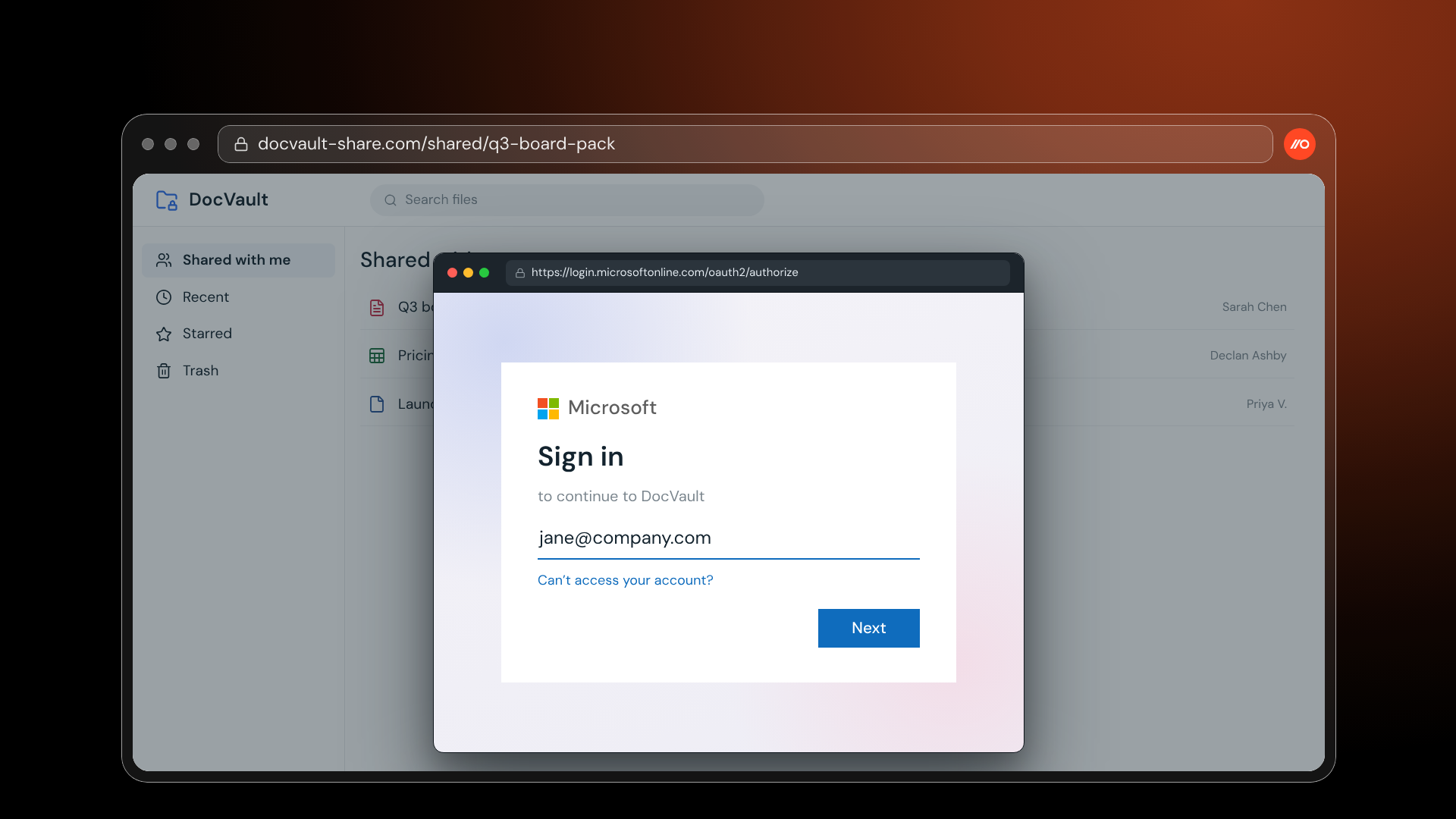
BitB in the wild. In March 2022, Google's Threat Analysis Group reported that Ghostwriter, a Belarusian threat actor, had added BitB to its credential phishing. Push documented Sneaky 2FA adding BitB in November 2025. In July 2026, Proofpoint reported that TA419 used a BitB overlay on Evilginx against US AI policy experts. In October 2026, researchers found a platform posing as ad tools for ChatGPT, Gemini, Claude, and other AI brands, where a live operator steered each victim through a BitB login and its MFA prompts.
Vishing and operator-run phishing panels
Some AiTM attacks put a human in the loop. The caller phones the victim, poses as the IT help desk, and stays on the line through each step: which link to open, what to type, and when to approve the MFA prompt. A real person on the line adds pressure, which makes the victim more likely to engage with the page and finish the login.
In May 2026, Push researchers gained access to Doko's Panel, the panel behind vishing and AiTM campaigns linked to ShinyHunters and the BlackFile group. Push found more than 400 phishing domains and several forks of the panel. Okta's research on Work Panel, a platform it links to Cordial Spider, shows the workflow. A caller talks the target through the login, while a manager moves the target's browser to the next screen, such as an MFA challenge, in real time.
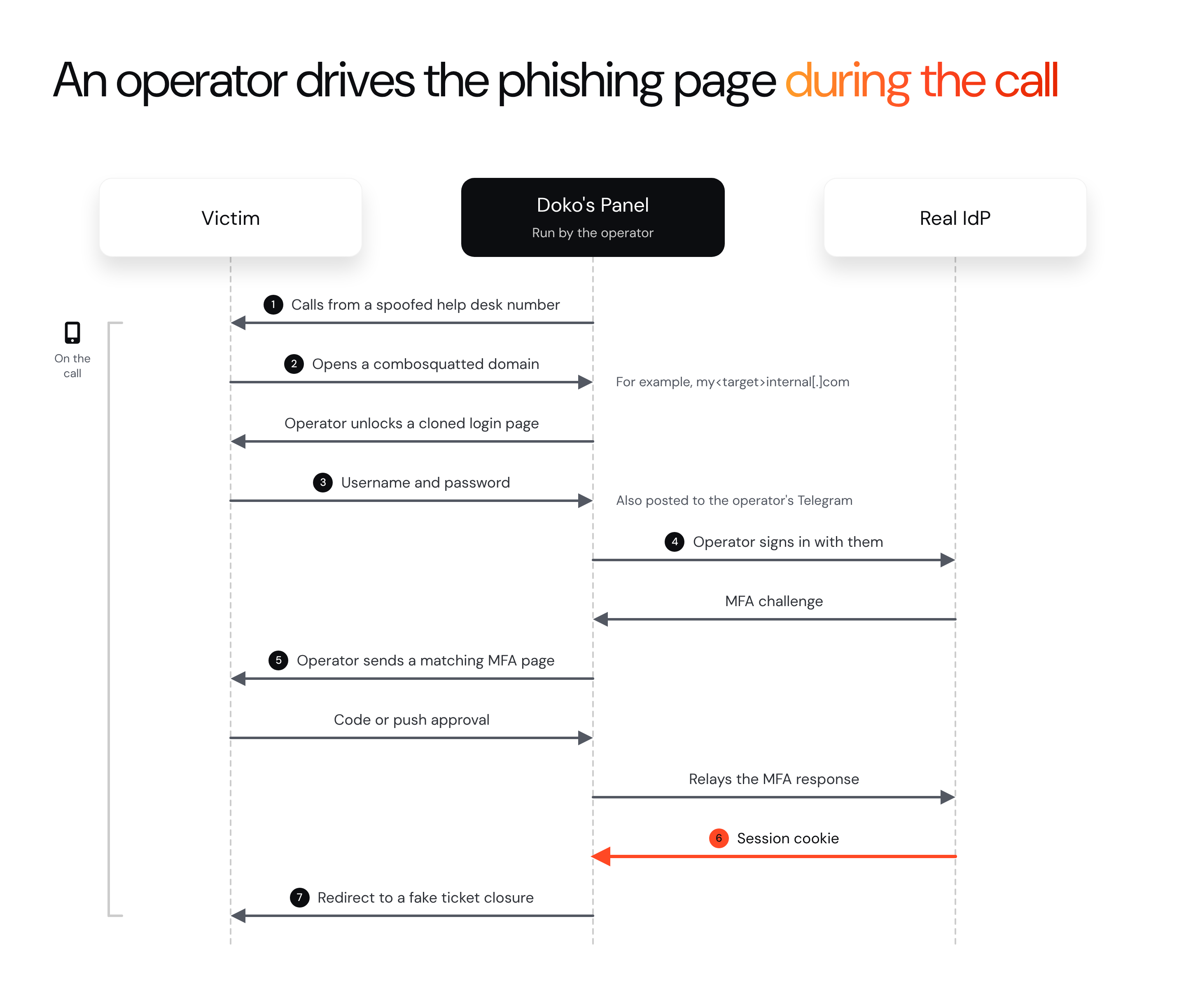
The same calls deliver other browser-based payloads like device code phishing too. Push's 2026 mid-year update named ShinyHunters, Pink, and Helix among the groups that use vishing for both techniques. A phone call has no email for a gateway to scan. The first part of the attack that runs on the victim's device is the page they open.
AiTM phishing kits and phishing-as-a-service
Commercial PhaaS kits sell AiTM capability to criminals as a subscription. The customer picks a template, loads a target list, and collects sessions from a panel or a Telegram bot. PhaaS kits still have the largest presence in Push's detections. But AI makes it easier for attackers to build their own kits, or to fork and adapt existing ones, so new kits and variants appear faster than before. Push now tracks more than 80 attacker kits in its detections.
The table below shows a few examples. Push's threat intelligence hub profiles many more, with each kit's techniques, targets, and breakthrough rate: how often the kit gets past security controls and reaches a user who can interact with it.
Kit | First seen | What stands out |
|---|---|---|
Kit: | First seen: 2023 | What stands out: By mid-2025, it accounted for about 62% of the phishing attempts Microsoft blocked. Europol, Microsoft, and Cloudflare disrupted it in March 2026, and it added device code phishing in May 2026. |
Kit: | First seen: 2022 | What stands out: One of the first AiTM kits sold as a service, with a simple interface for Microsoft 365 and Google accounts. |
Kit: | First seen: 2024 | What stands out: Reuses code from the W3LL Panel. It added BitB pop-ups in November 2025 and pages that change on every visit in July 2026. |
Kit: | First seen: 2024 | What stands out: Took over customers when Rockstar 2FA collapsed in November 2024. It adopted JavaScript VM obfuscation in 2026. |
Kit: | First seen: 2025 | What stands out: Proxies Google Workspace and Microsoft 365 sign-ins. Push rates its breakthrough rate as Extreme. |
Kit: | First seen: 2026 | What stands out: Believed to have grown out of NakedPages, and took over from it in March 2026. It targets corporate Google and Microsoft accounts, and Push rates its breakthrough rate as Extreme. |
Kit: | First seen: 2026 | What stands out: Arrives as fake invitations from brands like Paperless Post and evite. Operators relay the credentials by hand through Telegram, and Windows visitors often get an RMM tool download instead. Push rates it Extreme. |
Kit: Mamba 2FA and Whisper 2FA | First seen: 2024–2025 | What stands out: Picked up activity after the March 2026 Tycoon 2FA takedown. |
Kit: | First seen: 2024 | What stands out: Microsoft seized 338 of its domains in September 2025. |
Kit: | First seen: 2026 | What stands out: A commercial service built on Evilginx that automatically downgrades FIDO2 and passkey logins. |
Evilginx and other open-source frameworks
Not every AiTM attack uses a commercial kit. Evilginx is an open-source AiTM framework that Kuba Gretzky released in 2017 for authorized penetration testing. Criminals use its public code too. Lexfo found Microsoft 365 phishing crews running their own Evilginx forks, and BigBear 2.0 is a PhaaS service built on it. The FAQ below covers how Evilginx works, how attackers use it, and how to detect it.
Interchangeable payloads
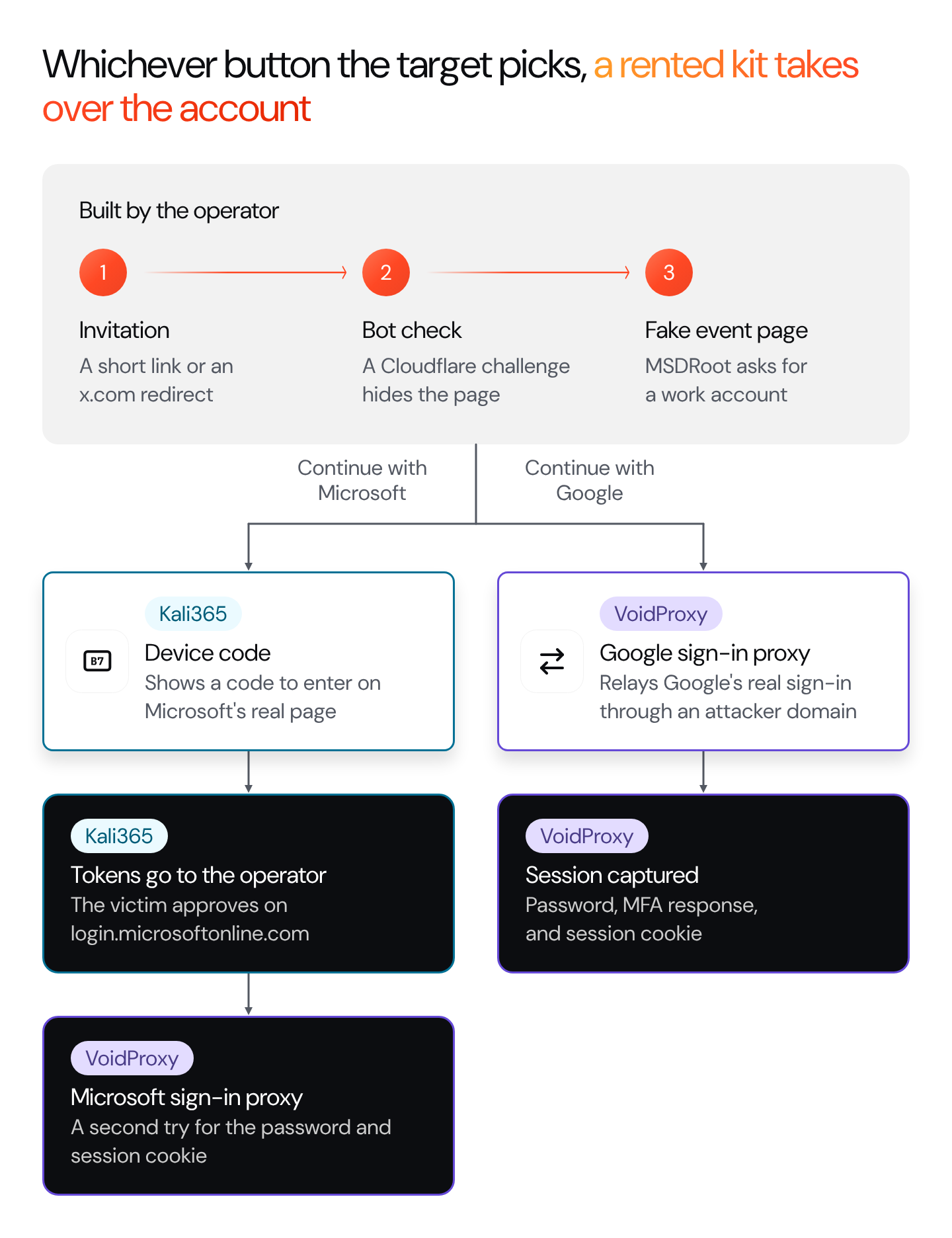
The delivery channel and the payload now vary independently. Whatever the channel, the page behind the link may run AiTM, ClickFix, a download of malware or an RMM tool, device code phishing, or several of these. Tycoon 2FA added device code phishing in May 2026, and Forg365 offers both techniques from the same panel. Device code phishing is a form of authorization phishing. The victim completes a genuine login, so passkeys don't stop it.
Takedowns and kit migration
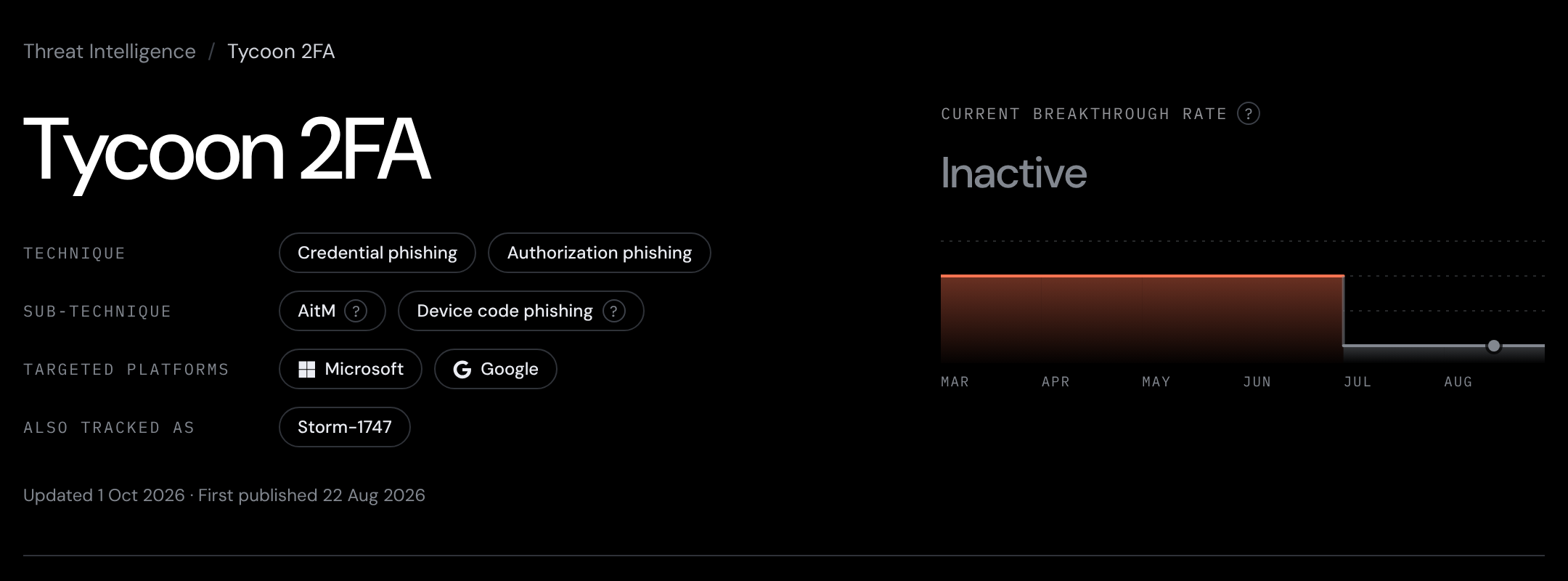
In March 2026, Europol, Microsoft, and Cloudflare disrupted Tycoon 2FA. CrowdStrike observed its volumes drop to 25% of their earlier level, then return to pre-disruption levels. Barracuda found its techniques "scattered everywhere," as rival kits upgraded with tools that Tycoon 2FA used before. Push's threat intelligence hub has listed Tycoon 2FA as inactive since July 2026, while Sneaky 2FA, FlowerStorm, and VoidProxy are still active. Detections tied to one named kit miss the same techniques when they appear in another kit.
AI in kit development
Kit developers use AI at several points. Some kits generate lookalike login pages from a screenshot. The Doko's Panel code that Push examined showed clear signs of LLM-generated code, so less skilled operators can build and fork their own panels. The AiTM technique itself is the same with or without AI.
/**
 * client.js - Client-side Session Tracking
 *
 * WHAT IT DOES:
 * - Generates/retrieves unique token (UUID) per browser
 * - Generates window ID per tab/window
 * - Stores in localStorage, sessionStorage, and cookies
 * - Polls backend for redirects from admin panel
 * - Sends heartbeats to keep session active
 *
 * GLOBAL VARIABLES EXPOSED:
 * - window.__token - The session token
 * - window.__windowId - The window/tab ID
 * - window.getToken() - Function to get token
 * - window.getWindowId() - Function to get window ID
 * - window.__dsBase - Base path for isolated DocuSign panels
 *
 * COOKIES SET:
 * - token - Session token (24h)
 * - okta_token - Alias for heartbeat (24h)
 * - window_id - Window ID (24h)
 *
 * POLLING:
 * - Calls /backend.php?action=check_redirect every 2 seconds
 * - If redirect found, navigates to that URL
 * - Only polls on gate (/index.php) and processing pages
 *
 * NOTES FOR NEXT SESSION:
 * - Token persists across page loads via localStorage
 * - Window ID changes per tab (sessionStorage only)
 * - All form submission pages use window.__token for logging
 */
What attackers do with a stolen session
An AiTM attack ends in account takeover. The attacker holds a valid, MFA-approved session and can do anything the victim can in the app. With an SSO session, that reaches every app connected to the identity provider. From there, attackers move laterally into other apps and accounts, and they often register their own MFA method to keep their access.
Most often, the goal is data. Of the 150 publicly disclosed breaches Push has tracked that started with phishing, vishing, or stolen credentials, about three in four ended with the attacker accessing or stealing data, often from connected SaaS apps like Salesforce, Snowflake, Jira, GitHub, and Zendesk. Public disclosures show only a small part of the real picture. Attackers also move fast: Unit 42 found that the quickest quarter of the intrusions it investigated in 2025 reached data exfiltration in 72 minutes.
Stolen data then becomes leverage for extortion. Attackers threaten to publish the data unless the victim pays. ShinyHunters is the best-known example. Since 2025, its callers have walked employees through phishing pages, from malicious Salesforce app approvals to fake SSO login pages, then exported company data and demanded payment. According to the FBI, ShinyHunters had breached more than 140 organizations and collected at least $70 million in extortion payments by the time its alleged leader was arrested in September 2026.
How AiTM kits evade detection
AiTM kits stack several evasion techniques on every page. Push's phishing detection evasion techniques resource maps them across each stage of a phishing attack. The ones AiTM kits lean on most are:
Disposable domains. 89% of phishing domains stay active for less than two days.
Hosting on trusted services. Tycoon 2FA ran its logic on Cloudflare Workers, and Storm-2755 routed victims through Google and Amazon S3 redirects.
Bot protection and gating. 95% of the attacks Push detects use some form of bot protection, such as Cloudflare Turnstile.
Anti-analysis checks. Tycoon 2FA checked for 230 security vendor names and for automation tools such as Selenium, Puppeteer, and Playwright.
Page obfuscation. Sneaky 2FA pages change their names, paths, and tokens on every visit, and FlowerStorm runs its code in a JavaScript virtual machine.
Delivery outside email. One in two payloads Push intercepts arrive outside email, through search ads, social media, messaging apps, and phone calls.
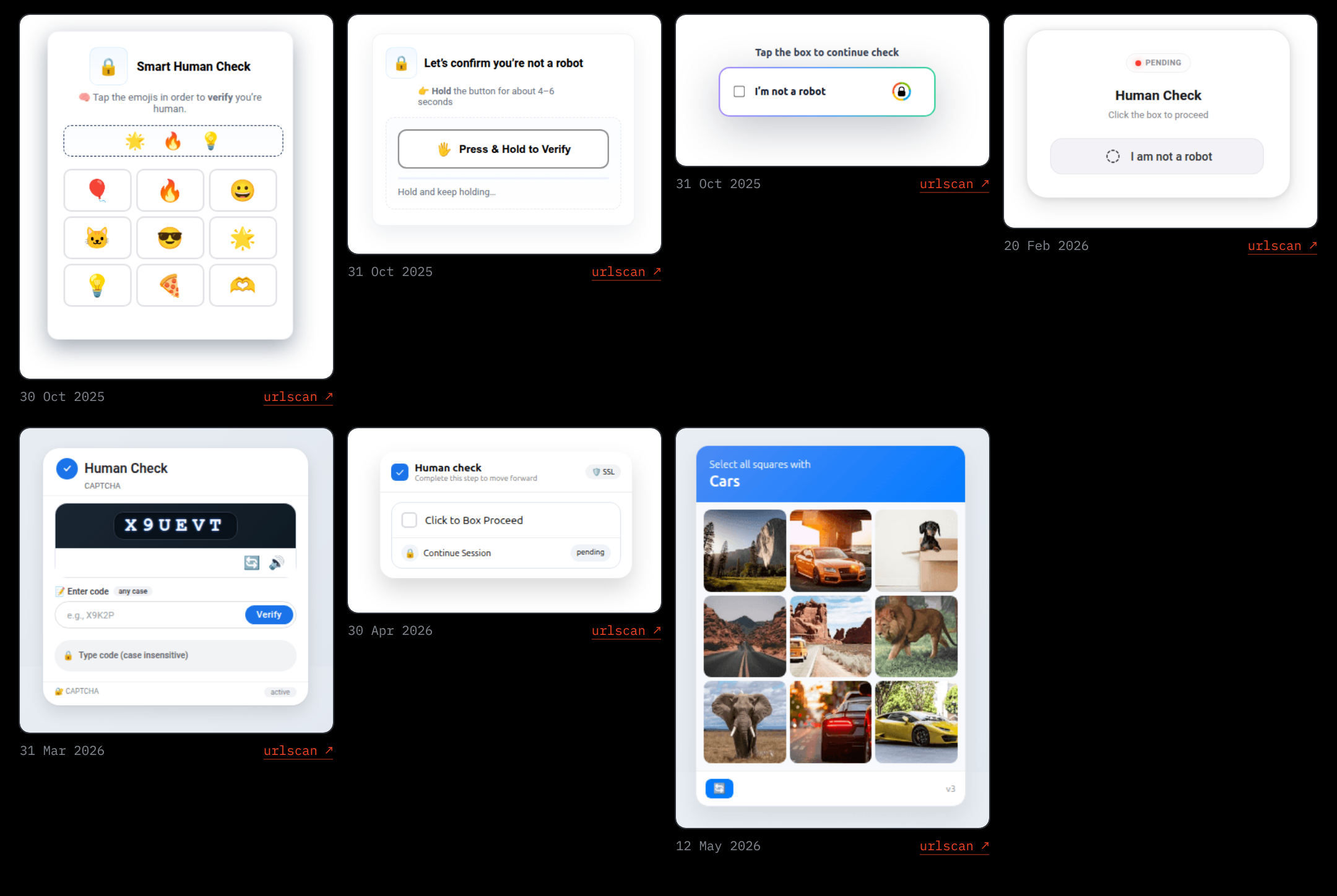
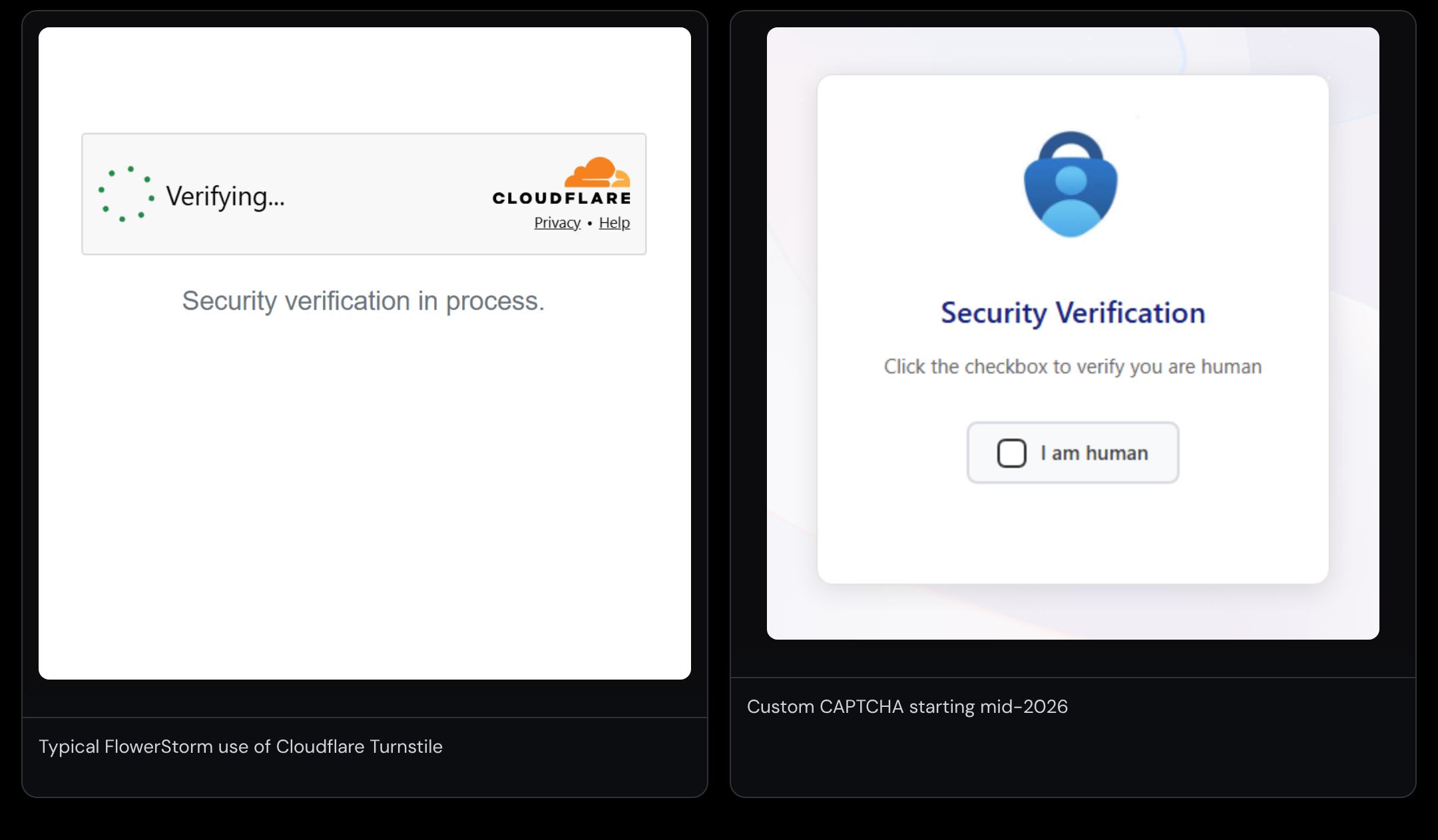
Most security controls judge a page by what's already known about it: its domain, its reputation, a signature of its code, or what a scanner saw when it visited. AiTM kits are built to take each of those away. New domains have no history, and trusted platforms lend the page a good reputation. Bot checks show scanners a harmless page, and obfuscation changes the code on every visit.
By the time the victim sees the login page, the bot checks have passed and the page's JavaScript has run. At that point, the page in the victim's browser shows its real behavior.
How to defend against AiTM phishing
AiTM phishing crosses the lure, the page, the login, and the session that follows. Each of the controls below applies to one of those stages.
Phishing-resistant MFA and fallback methods
FIDO2 security keys, passkeys, and Windows Hello for Business bind the login to the real site's domain, so a proxy can't complete it. They only protect the account if the attacker can't choose something weaker. Most accounts still have a phone number, an authenticator app, or a password as a backup, and kits now hide the passkey option so the victim falls back to one of these.
Push's research on MFA downgrade attacks shows how this works. Where you can, it's worth taking phishable methods off accounts that have a passkey.
// Analyst comment: Suppresses the 'Use your passkey' option by making it invisible and not clickable.
function removePasskey() {
    var challengeList = document.querySelectorAll(".aZvCDf");
    if (challengeList) {
        challengeList.forEach((challenge) => {
            if (challenge.innerText == "Use your passkey") {
                challenge.style.pointerEvents = "none";
                challenge.style.display = "none";
            }
        });
    }
}
var intervalID3 = setInterval(removePasskey, 500);

// Analyst comment: Clicks the 'Not now' button to prevent user from creating a passkey.
function skipEnablePasskey() {
    var buttons = document.querySelectorAll(".VfPpkd-vQzf8d");
    var isEnablePasskeyPage = Array.from(
        document.querySelectorAll(".dMNVAe")
    ).find((element) => {
        return element.textContent.startsWith(
            "Only create a passkey if this is your device."
        );
    });
    if (isEnablePasskeyPage) {
        buttons.forEach((element) => {
            if (element.textContent == "Not now") {
                element.click();
                clearInterval(intervalID4);
            }
        });
    }
}
var intervalID4 = setInterval(skipEnablePasskey, 500);

// Analyst comment: Clicks 'Try another way' button to prevent use of passkey.
function skipPasskey() {
    var header = document.querySelector("#headingText");
    if (header.textContent == "Use your passkey to confirm it's really you") {
        var skip_button = Array.from(document.querySelectorAll("button")).find(
            (element) => {
                return element.textContent.startsWith("Try another way");
            }
        );
        if (skip_button) {
            skip_button.click();
            clearInterval(intervalID5);
        }
    }
}
var intervalID5 = setInterval(skipPasskey, 500);
Phishing-resistant MFA also doesn't stop authorization phishing, such as device code and OAuth consent phishing, where the victim completes a genuine login and then grants access.
Session controls that don't stop AiTM
Several session controls sound like they should stop AiTM, but they don't:
Token Protection. Microsoft Entra's Token Protection binds tokens to the device, but it covers native apps. AiTM kits steal browser sessions, which it doesn't protect.
Device Bound Session Credentials (DBSC). Chrome's DBSC stops a copied cookie working on another device. A proxy can strip the registration and capture a session that was never bound.
Shorter sign-in frequency. Forcing users to sign in again shrinks the attacker's window but doesn't close it. Attackers often register their own MFA method within minutes, so they can sign in again too.
Responding to a suspected AiTM compromise
If you suspect an AiTM compromise, start with the IdP and app logs, and look for:
New MFA methods, passkeys, or devices, especially right after a sign-in
A session used from a different IP address or hosting provider than the login
New inbox rules, OAuth app consents, API keys, or local passwords on SSO apps
A password reset alone doesn't end an AiTM compromise, because the attacker already holds a valid session. A response needs to:
Revoke the user's sessions and refresh tokens.
Remove any MFA methods and devices the attacker added.
Check connected apps for inbox rules, OAuth grants, API keys, and ghost logins.
Find the lure and the phishing page, and check whether other users received or visited them.
How Push stops AiTM attacks
Preventive controls built on blocklists can't keep up with rapidly rotating phishing domains. Stopping these attacks means finding malicious pages in real time: analyzing each page as it loads in the browser, identifying malicious content as it appears, and blocking it before the victim enters anything. Push's browser extension does this for AiTM kits, BitB pop-ups, and cloned login pages, based on what the page does rather than its domain. See how Push stops adversary-in-the-middle attacks.
Frequently asked questions about AiTM phishing
AiTM stands for adversary-in-the-middle. In phishing, it describes an attack where the attacker's server sits between the victim and a real login page and relays the login in real time. You'll also see it written as AitM, or called attacker-in-the-middle or reverse proxy phishing.
The two terms describe the same idea: an attacker positioned between two parties who relays and reads their traffic. MitM usually refers to attacks on the network, such as a rogue Wi-Fi access point. AiTM phishing is the web version, where the victim visits the attacker's site and the attacker relays the login to the real site. Some vendors and reports still call it MitM phishing, so you'll see both names used for the same attack.
It relays the MFA step. SMS codes, authenticator app codes, push approvals, and number matching all get relayed through the proxy, and the attacker receives the session after the victim completes MFA. Phishing-resistant MFA such as FIDO2 security keys and passkeys does stop the relay, because the credential only works on the real site's domain.
Passkeys stop the relay itself, but attackers have two ways around them. Many kits remove the passkey option from the page and push the victim to a weaker backup method, which is known as an MFA downgrade attack. Kits also switch to device code phishing, where the victim completes a genuine login on the real site and hands over the authorization.
AiTM phishing creates a new session and captures it during the login. Session hijacking, also called token replay, steals a session that already exists, often from an infostealer infection, and replays it. Both leave the attacker with a valid session, but they start in different places and need different controls.
AiTM phishing steals the session the victim creates when they log in. Authorization phishing works after the login: the victim signs in on the real site, then approves access for the attacker through a device code or an OAuth consent prompt. The login itself is genuine, so passkeys and other phishing-resistant MFA don't stop authorization phishing. Many kits now offer both techniques, so operators can switch to device code phishing when AiTM doesn't work.
Evilginx is an open-source AiTM phishing framework. It proxies a real login page, captures the username, password, and session cookies, and so bypasses most MFA. Kuba Gretzky released the first version in 2017 for authorized penetration testing. Evilginx 3 is now a standalone application, and a commercial edition, Evilginx Pro, adds bot protection and detection evasion for red teams.
Evilginx is a transparent reverse proxy. The operator configures it with a phishlet, which is a file that lists the target site's hostnames, the form fields that hold credentials, and the session cookies that show a login is complete. The operator then sends the victim a lure link. Evilginx serves the real login page from the attacker's domain and records the credentials and cookies. The operator imports the cookies into a browser to take over the account.
The most active kits change from month to month, as kits fork, rebrand, and get disrupted. Push's threat intelligence hub ranks the phishing kits it detects in customer browsers by breakthrough rate, which measures how often a kit gets past security controls and reaches users. It also profiles each kit's techniques and targets.
You can detect AiTM phishing at three points. In the browser, you can analyze the login page as it renders and spot a known IdP's page on an unrelated domain. In IdP logs, you can look for a session used from a different IP address or hosting provider than the login. After access, you can watch for new MFA methods, devices, inbox rules, and OAuth grants. Only the browser check can act before the session is stolen.